How AI has made AP recovery audits redundant

Mar 2026
.png?length=1024&name=Cutting%20the%20loop%20-%20CMS%20Thumbnail%20(1).png)
Every AP leader knows the recovery audit story: money goes out, and months later, someone tells you they’ve found some of it, for a 20% fee.
These audits have long been the traditional safety net in Accounts Payable and seemingly, the only scalable way to tackle overpayment problems. They're familiar, they're often framed as low-risk and they can produce a headline figure that looks like a win: "We recovered money."
The problem is that with current AI technology, recovery audits have moved from a solid control to ineffective. They're time-consuming, expensive, bad for supplier experience and don't stop the same leakage from happening again. Crucially, they can leave AP stuck reacting to problems months or years after cash has already left the business.
This is the old way. But it doesn't have to be the only way.
If you want to reduce financial leakage in a lasting way, the goal can't be to recover what fell through the cracks. It has to be to prevent it from slipping through in the first place. And AI makes this possible.
The numbers: Recovery audits don't close the leakage gap
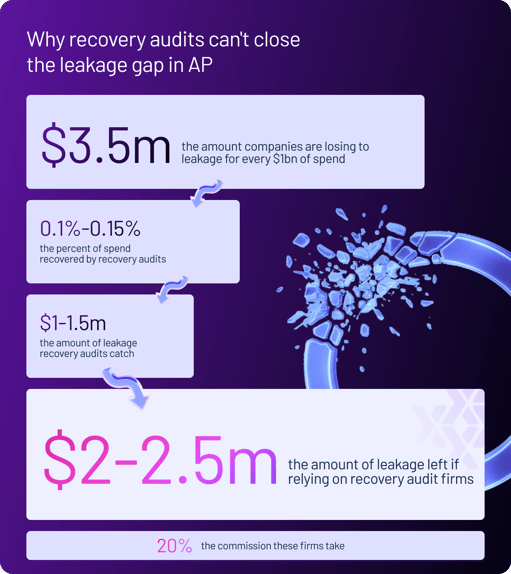
Financial leakage isn't a rounding error. On average, companies lose around $3.5m for every $1bn of spend to leakage, including duplicate payments, missed credit notes, invoice errors and fraud. Recovery audit firms typically only recover 0.1-0.15% of annual AP spend, which would only be $1-1.5m of that $1bn. That difference matters, because it means you can run audits year after year and still leave a meaningful share of value untouched. Not to mention, audit firms typically take around 20% commission on the funds they find.
That gap isn't because leakage is impossible to find. It's because the traditional recovery audit model requires a lot of manual work from AP teams. These limitations were once unavoidable, but agentic AI now makes it possible to close that gap proactively, not just recover a fraction after the fact.
Here’s where recovery audits fall behind:
Recovery firms prioritise low-hanging fruit, leaving untapped opportunity
Recovery audit firms often focus on vendors with the highest percentage of spend, where material recoveries are easiest to find.
Retroactive recovery creates financial inaccuracy and damages supplier relationships
Because recovery audits are backward-looking, funds aren’t recovered in the period they were incurred, leading to inaccurate financials, including costs of goods sold (COGS). Additionally, chasing suppliers for overpayments from months or even years ago can strain relationships, and in many cases, these funds may no longer be recoverable.
The recovery process is time-consuming for AP teams
Even when recovery audits promise to be quick exercises, the actual process of recovering funds takes significant time. AP teams must go back and forth with vendors to validate findings, gather evidence and negotiate repayments, all of which diverts resources from more strategic work.
So, even when a recovery audit recovers meaningful cash, it's not designed to close the full leakage gap. It delivers partial recovery instead of comprehensive control.
Financial leakage report 2026
The result: Ongoing leakage that drains cash and erodes trust, from the AP team to the C-suite.
The status quo: Why are AP teams still using recovery audits?
Recovery audits have become the default option for many AP teams, not necessarily because they're the best solution, but because they've historically been the only scalable way to tackle overpayment problems. For years, they were the standard approach when internal controls couldn't keep pace with invoice volumes, data complexity and cross-entity operations.
But what started as a periodic diagnostic tool has, for many organisations, become a recurring dependency. And that's created an endless cycle: errors slip through, a third party finds them months or years later, the business pays a commission to recover money that shouldn't have left in the first place and the underlying weaknesses remain. The same issues resurface in the next audit, and the loop continues.
This cycle isn't just costly. It's a signal that the traditional model is no longer fit for purpose.
The loop of dependence recovery audits create
When recovery audits become routine, they can create a loop:
- Errors slip through.
- Months or years later, a third party finds them.
- The business pays a success fee to recover money that shouldn't have left the business.
- The underlying weaknesses stay in place.
- The same error types show up again next cycle.
It's a reactive model. By the time you find the issue, cash has already left the account and you're managing fallout: supplier conversations, internal escalations, rework and exception handling.
It can also become an expensive pattern. Contingency fees might feel painless at the start, but they add up. A commonly cited commission is around 20% of recovered value. Recover £500,000, and you might pay £100,000 in fees. Repeat that annually and it becomes a recurring "tax" on the same vulnerabilities.
Over time, that can distort decision-making. Leakage starts to feel normal because you push it to the next audit. That's the real risk: not that recovery audits recover nothing, but that they make recurring leakage feel acceptable.
How to break the loop: Shift from recovery to prevention
Breaking the loop means changing what control looks like.
Traditional approaches rely on fixed rules and periodic reviews. But AP data is too variable, and the long tail is too big, for that to consistently work. This is where agentic AI changes the equation. It moves you from the traditional reactive approach to proactive prevention at scale, making it possible to detect issues before payment, not months after.
A prevention-first approach is built around:
- Detection before the pay run. Issues are flagged in the moment, before payment.
- Learning from your historic data. Controls improve based on patterns in your invoice population, which creates high accuracy rates based on your data.
- 100% transaction coverage. Prevention isn't just for top suppliers. Continuous monitoring can cover every transaction across entities and ERPs, including the long tail where small errors accumulate.
- Root-cause visibility. Prevention gets stronger when you can see why issues happen: duplicate vendor records, tolerance settings that are too broad, inconsistent invoice numbering, OCR errors, human errors or process deviations across entities.
- Continuous monitoring instead of periodic look backs. You aren't waiting for the next audit cycle to learn what slipped through.
This shift is bigger than "catching duplicates." When AP can prove proactive control over leakage, it becomes easier to demonstrate measurable risk reduction and ROI. AP moves from being judged on exceptions to being recognised for protecting cash and strengthening financial controls.
How Xelix helps
Recovery audits were built for a world where prevention at scale wasn’t possible. But that world has changed. Xelix uses agentic AI to help you move from reactive recovery to proactive prevention, replacing manual, backward-looking audits with continuous, intelligent control.
1) Start with evidence with a historic audit
As part of going live, Xelix runs an AI-powered historic audit to surface recoverable items (typically 0.25%–0.5% of annual spend) - with no commission.
2) Then, prevent leakage before it leaves the business.
Continuous monitoring reviews 100% of transactions across all entities and ERPs, learning from your data to detect overpayments and anomalies before payment.
3) Close the loop at the source.
Root-cause insight helps AP teams fix systemic issues, like duplicate vendor records or tolerance settings, so errors don’t repeat.
Recovery audits were the traditional solution and the only way to tackle overpayments at scale. But agentic AI offers a new way forward: moving from reactive recovery to proactive prevention, breaking the cycle for good.
Content that may catch your eye
.png?length=720&name=Blog%20feature%20images%20-%20720x369%20(4).png)
.png?length=720&name=Using%20AI%20to%20build%20world-leading%20duplicate%20invoice%20prevention%20software%20(2).png)