
.png?length=1024&name=How%20Accounts%20Payable%20teams%20make%20time%20for%20higher%20value%20work%20(1).png)
At every P2P conference we attend, we always hear how stretched AP and shared services teams are. Query volumes up, headcount flat, and somewhere in the background, a leadership message to "be more strategic." It's well-meaning but it's also hard to square with an AP helpdesk still processing the same types of vendor queries it was processing two years ago.
At the Procure to Pay network event, hosted by The Shared Services Forum UK, we ran a live benchmarking session with 40 shared services and P2P leaders to get closer to the real question: are AP teams busy with the right work?
The focus was vendor queries - an unglamorous, time-consuming, and frequently dreaded part of the function, and the place where most of the unnecessary volume actually sits.
Baseline -> benchmark -> best practice in Accounts Payable
The framework behind the session is simple enough: you can't benchmark without a baseline, and you can't drive best practice without a benchmark. Most teams know this in theory; the harder question is whether they have the data to do it.
For vendor query management, a useful baseline means consistently capturing first response time, resolution time, SLA attainment, escalation rate and why queries are arriving in the first place. The first two metrics came back solid. Most participants tracked response and resolution times: 44.7 hours average first response, 56.4 hours average resolution. SLA attainment and escalation rates were patchier, with some teams measuring both and others neither.
But the number that changed the energy in the room was root cause.
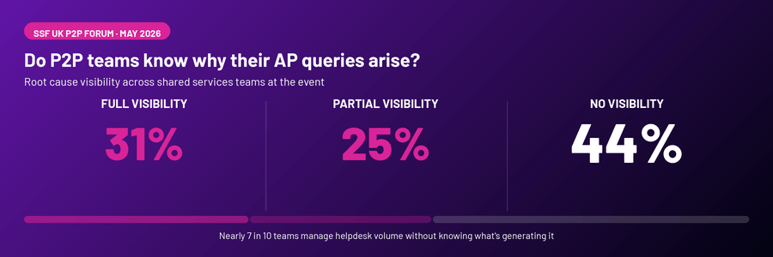
Only 31% of participants had full visibility into why their AP queries arise
Nearly seven in ten teams are managing an Accounts Payable helpdesk volume without knowing what's generating it and that gap is the difference between running a busy function and running an effective one.
What root cause analysis actually tells you
Without root cause data, you can manage query volume. You can't reduce it. That distinction matters more than it sounds, because the volume isn't inevitable.
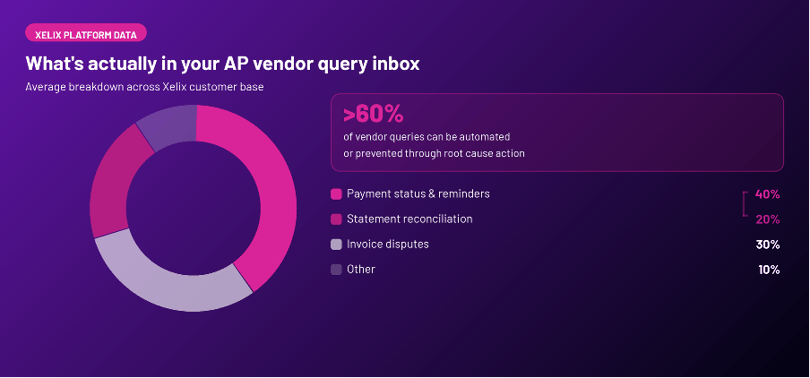
Our data across Xelix customers breaks vendor helpdesk queries into three dominant categories: around 40% are payment status or payment reminder requests - suppliers contacting AP to find out when they'll be paid, around 30% are invoice disputes, and roughly 20% are statement reconciliation queries. Together these three categories account for the vast majority of what lands in an AP inbox or ticket system, and most of them can be handled for you rather than teams spending valuable time working through them manually.
Payment-status queries exist because of an information gap: suppliers don't know when they'll be paid, so they ask. The fix isn't faster response times, it's proactive communication so the question doesn't arise.
Invoice disputes need a clear process for categorising, routing and resolving by dispute type. And statement reconciliation is one of the most time-consuming manual processes in AP, but also one of the most automatable, with the right tools in place.
Xelix's automated statement reconciliation module handles supplier statement matching end-to-end, pulling directly from your ERP. Around 200 customers are using it right now, and the time savings are significant (more on that below).
The deeper point is that root cause visibility makes these categories visible and therefore addressable. Without it, you're resolving queries. With it, you're preventing them.
What could your AP team do with 60% of their time back?
In the session at SSF UK, we asked the room a question from the presentation: "If you could reduce resolution times by 60% whilst improving SLA performance to 90%+, what would that additional FTE capacity and supplier confidence be worth to your organisation?" Nobody needed long to think about it.
When you strip out the payment-status queries (roughly 40% of volume) and the statement reconciliation queries (roughly 20%), you're looking at potentially 60% of your current helpdesk workload that could either be automated or prevented entirely, not reduced or streamlined… gone.
That's worth sitting with. Not "how do we handle queries faster?" but "what could our AP team be doing if they weren't doing this?" For most teams, the answer is the work that finance leadership has been asking for: strategic supplier relationship management, commercial analysis, supporting the business on payment terms and working capital decisions - the work that moves the needle and enables AP teams to showcase their strategic thinking.
What it looks like in practice?
Huntsman is a global speciality chemicals company that has been through this journey. Dana Pearson, their Director of S2P Global Process, has spoken openly about what the move to automated vendor query management made possible for the team.
The pattern across customers who reach this point is consistent: once the preventable query categories are addressed, AP teams don't just run more efficiently, they operate differently. The function becomes proactive rather than reactive, and supplier conversations shift from "where's my payment?" to discussions about terms, relationships, and commercial value. That's what best practice looks like.
Accounts Payable compliance
This all matters more in 2026 for UK-based operations and understanding why requires thinking about root cause and resolution together rather than as separate issues.
The April 2026 late payment reforms introduced a 30-day dispute resolution window, mandatory board-level payment scrutiny, fines for persistent late payers, and new annual reporting obligations. Businesses bidding on public sector contracts over £5m must also demonstrate 45-day average payment performance. The upshot is that payment practice data, which previously sat in the AP team's inbox, is now being read by audit committees and boards.
Against that backdrop, a 56.4-hour average resolution time is a material concern. But what makes this more than just a speed problem is what happens when teams lack root cause visibility. Without knowing what their queries consist of, teams have no way to triage intelligently. A payment reminder that's approaching its due date carries very different urgency from a general billing query, but without intelligent inbox or ticketing capabilities, both sit in the same queue and get processed in the same order.
Xelix supports custom query categories, which means our AI can categorise and label payment reminders close to a due date as urgent and route them for same-day resolution. Invoice disputes from strategic suppliers can go directly to the right person. Escalations become something you manage proactively rather than react to. Right now, for most of the teams, none of that is possible because they can't see what their queries consist of.
It's rarely for lack of trying either. Without the baseline numbers to build a credible business case, teams can't secure the investment that would surface them in the first place. That's the circularity the session was designed to help break.
Where to go from here
For teams ready to act: Xelix's AP Helpdesk module connects directly to your ERP, classifies and routes vendor queries automatically with customisable categories, and handles the payment-status workload without manual intervention. The statement reconciliation module addresses the recs volume end-to-end. Root cause data surfaces as a byproduct of both, which means the benchmark and best practice conversation becomes ongoing rather than a one-off exercise.
Whether or not technology is the right next step right now, the starting point is the same: get the baseline in place. Know your resolution time, your SLA performance, your escalation rate, and most importantly, find out what your queries actually consist of.
Most AP functions have more capacity for valuable work than their current query load leaves room for. A clear picture of what that load actually consists of is usually the thing that unlocks it.
Interested in benchmarking your vendor query process? Get in touch.